The relationship between freezing temperatures and driveway cracking is the defining pavement maintenance challenge for Warwick, Rhode Island homeowners. Rhode Island’s position in southern New England gives it one of the most damaging winter climates for asphalt pavement in the United States not because of the absolute severity of its cold (Warwick winters are milder than interior New England), but because of the frequency with which temperatures cross back and forth across the 32-degree Fahrenheit freezing point throughout the winter season. This crossing the freeze-thaw cycle creates the specific physical mechanism by which water destroys asphalt pavement from within. Understanding this mechanism in detail, recognizing why Warwick is particularly vulnerable to it, and knowing the specific interventions that interrupt it gives property owners the knowledge to protect their Driveway Cracks Freeze Thaw Warwick investment through the season most likely to shorten it.
The Physics of Freeze-Thaw Crack Formation and Growth
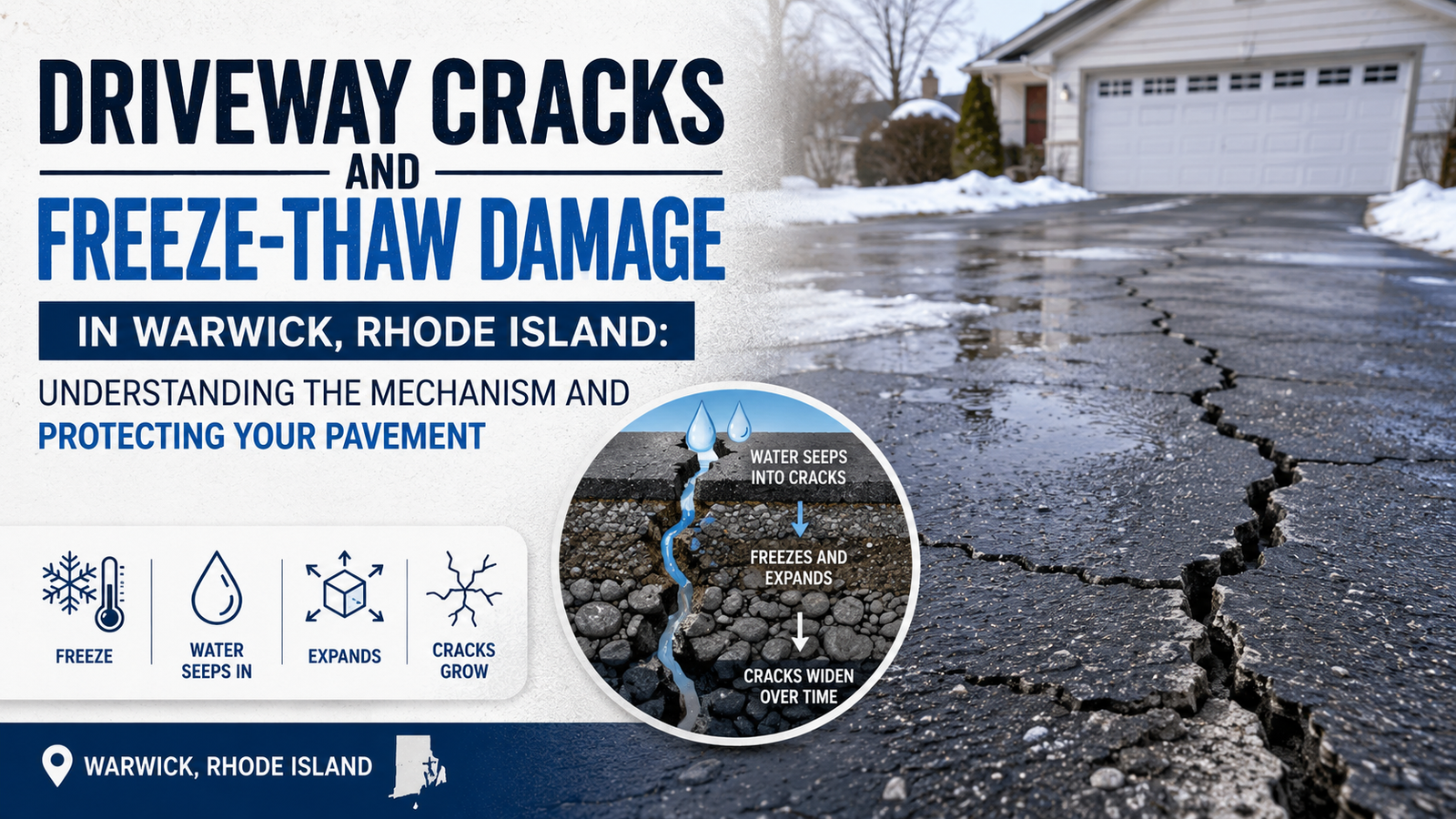
Water expands by approximately nine percent when it freezes. This physical property the same one that makes ice float on liquid water and that requires expansion joints in concrete bridges becomes highly destructive when it occurs within the confined space of a pavement crack or pore. The sequence of events that converts a minor surface crack into a structural failure is predictable, measurable, and preventable at its early stages but becomes progressively more expensive to reverse as it advances.
A crack in the asphalt surface formed through UV-driven binder oxidation, thermal shrinkage, heavy vehicle loading, or subbase movement creates an opening in the pavement’s surface film. When rain or snowmelt water enters this opening, it fills the crack void and penetrates downward through the asphalt layers toward the aggregate base. When ambient temperatures then drop below freezing while this water is present within the crack system, the water expands as it converts to ice, pressing outward against the crack walls with hydraulic force. This hydraulic pressure exerted by the expanding ice against the confining crack walls is what widens the crack mechanically, without any additional surface loading from vehicles.
When temperatures rise above freezing again which happens repeatedly throughout a Warwick winter the ice melts, and the now-liquid water can flow deeper into the pavement structure before the next freeze event traps it and expands it again. Each successive freeze cycle finds water penetrating deeper, crack walls having been pushed slightly farther apart, and a slightly larger ice volume creating slightly greater hydraulic pressure in the next cycle. The cumulative effect over 30 to 50 Rhode Island freeze-thaw cycles in a single winter season is a crack that has been mechanically widened from a hairline surface defect into a visible structural opening that allows water to reach and saturate the aggregate base below.
Why Warwick’s Coastal Climate Creates Particularly Intense Freeze-Thaw Damage
Rhode Island experiences one of the most damaging freeze-thaw cycle profiles in the entire United States, and Warwick’s coastal location near Narragansett Bay gives it a specific version of this climate profile that is more damaging in a counterintuitive way than colder inland locations.
The frequency of freeze-thaw transitions not the absolute severity of the cold is what makes Rhode Island’s climate so damaging to asphalt. Interior continental climates that freeze hard in winter and stay frozen for extended periods produce relatively few freeze-thaw cycles, because temperatures remain consistently below freezing for days or weeks at a time. Rhode Island’s maritime climate, moderated by the Atlantic Ocean and Narragansett Bay, produces temperature patterns that frequently oscillate across the 32-degree threshold. A typical Rhode Island winter includes 30 to 50 or more freeze-thaw cycles days when temperatures rise above freezing followed by nights or early mornings when they drop below. Each temperature crossing is one potential damage event for any crack that contains water.
Warwick’s coastal location amplifies this effect by keeping temperatures closer to the freezing threshold more consistently than inland communities. A location that fluctuates between 25°F and 38°F repeatedly through a winter day and night is producing freeze-thaw cycles. A location that drops to 10°F and stays there for three days is not, even though it is colder. Warwick’s Narragansett Bay influence tends to moderate the extreme cold that would keep temperatures well below freezing for extended periods, while still allowing regular dips below freezing overnight. The practical result is that Warwick may experience more freeze-thaw cycles per winter than colder inland Rhode Island communities, despite having less extreme temperatures.
Road salt and de-icing products applied to Warwick streets and tracked onto driveways by vehicle tires compound the freeze-thaw damage by lowering the effective freezing point of water on and in the pavement surface. A pavement surface that would undergo one freeze-thaw cycle during a temperature window from 25°F to 34°F may undergo two or three in the same window when chloride-based de-icing products are present, multiplying the mechanical damage per season.
How Freeze-Thaw Damage Progresses Through Three Distinct Stages
Understanding the progression of freeze-thaw damage from its earliest visible stages to its most destructive allows Warwick homeowners to recognize where their driveway is in the damage progression and respond at the optimal point which is always the earliest possible.
Stage One: Initial Surface Cracking
Before freeze-thaw damage can occur, cracks must first develop in the asphalt surface. In Warwick, the primary cause of initial crack development is UV-driven binder oxidation the sun’s ultraviolet radiation progressively hardens the asphalt binder, making it brittle, until thermal contraction during cold weather causes the surface to crack transversely (perpendicular to the driveway length) when the contraction stress exceeds the tensile strength of the oxidized material. Additional crack initiators include thermal cycling stress from repeated daily temperature changes, subbase settlement that creates surface flexure, and heavy vehicle loading that fatigues the surface over time.
Stage One cracks may be hairline to one-quarter inch wide and may appear superficially cosmetic the pavement beneath is still structurally sound, and the cracks have not yet allowed significant water infiltration to the base. This is the optimal intervention point, where the cost of repair is lowest and the protective benefit is highest. Hot-pour rubberized crack sealant applied at Stage One fills the crack void, bonds to the crack walls, and creates a flexible seal that maintains its effectiveness through Rhode Island’s temperature cycling. A Warwick driveway with all Stage One cracks sealed before winter has essentially eliminated the freeze-thaw water entry pathway for that season.
Stage Two: Crack Widening and Early Base Moisture
Without crack sealing intervention, one or more Rhode Island winters of freeze-thaw cycling progressively widen the Stage One cracks and drive water deeper into the pavement structure. By Stage Two, cracks that were hairline at Stage One may have widened to a quarter inch or more. Water infiltrating through these widened cracks has begun reaching the aggregate base, saturating the base material during wet periods and weakening its load-bearing capacity. During each freeze event, water now present in the base layer freezes and expands, creating frost heave that further disrupts the pavement surface from below in addition to the widening effect at the crack surfaces themselves.
Stage Two crack sealing is still effective but requires more preparation to achieve a durable result. Cracks wider than a quarter inch may need to be routed creating clean, parallel crack walls using a saw or router before filler application, to improve the adhesion surface and ensure complete fill of the crack void. Routing also removes weakened, oxidized asphalt at the crack edges that could debond from the filler material prematurely. The investment in proper crack preparation at Stage Two pays dividends in filler longevity. Crack sealing at Stage Two can stabilize the crack against further water infiltration, but cannot reverse the damage to the crack walls or any base weakening that has already occurred.
Stage Three: Base Failure and Alligator Cracking
Stage Three represents the transition from surface maintenance to structural repair. The aggregate base has been repeatedly saturated by infiltrating water, weakened during wet periods when its load-bearing capacity is reduced, and disrupted by frost heave during freezing periods. The asphalt surface above the compromised base no longer has adequate structural support it deflects under vehicle loads, and the repeated deflection fatigues the asphalt until it begins to crack in the alligator pattern that signals irreversible base failure. Alligator cracking cannot be corrected by crack sealing or resurfacing; it requires full-depth repair or driveway replacement to remove the failed base and install a new structural section.
The Five Types of Cracks That Appear in Warwick Driveways and What They Mean
Transverse cracks run perpendicular to the driveway’s long axis and are the most common freeze-thaw-related crack pattern in New England driveways. They form when thermal contraction of the asphalt during cold weather causes the material to shrink along its length when contraction stress exceeds tensile strength, the surface cracks perpendicularly to the direction of contraction. Transverse cracks in Rhode Island are so predictable that they are considered a normal aging characteristic of asphalt in this climate rather than an indicator of imminent failure. They must be sealed promptly to prevent freeze-thaw widening, but their presence alone does not indicate that resurfacing or replacement is immediately needed.
Longitudinal cracks run parallel to the driveway’s long axis. They form from a combination of binder oxidation (which causes the surface to shrink as volatile components are lost), traffic-related fatigue along wheel paths, and differential settlement between the pavement and any longitudinal joints from adjacent concrete or asphalt surfaces. Like transverse cracks, they should be sealed promptly without indicating base failure on their own.
Block cracking produces a roughly rectangular pattern across the surface, creating a grid of large blocks separated by cracks in both longitudinal and transverse directions simultaneously. Block cracking is a sign of advanced binder oxidation throughout the surface layer the asphalt has become so brittle that it cannot accommodate thermal movement in any direction without cracking. Block cracking indicates that sealcoating is overdue and that the sealcoating applied now will be working to protect a more oxidized surface than an earlier application would have encountered. Crack sealing of the block cracks followed by sealcoating is the appropriate response when block cracking appears without underlying base failure.
Reflection cracks appear in new asphalt over an existing crack, joint, or other discontinuity in the underlying structure. When a driveway is resurfaced, cracks in the old surface that were not fully addressed before overlaying will reflect through the new asphalt layer as the underlying structure continues to move. In Warwick’s climate, freeze-thaw cycling accelerates the rate at which reflection cracks progress from the subsurface crack through the new overlay to the new surface. Addressing existing cracks and joints in the old surface before overlaying routing and sealing, or full-depth patching reduces reflection cracking in the new overlay.
Alligator cracks form the interconnected, polygon-shaped network that signals base failure. They are the most serious crack pattern because they indicate that the underlying structure has been compromised to the point where overlay alone will not restore functional performance. Full-depth repair or replacement is the appropriate response to alligator cracking.
The Warwick Homeowner’s Annual Freeze-Thaw Protection Calendar
Fall maintenance September through October is the single most important maintenance window in Warwick’s annual driveway management calendar. Before the first significant freeze event, inspect the driveway surface systematically for any new or widened cracks. Seal everything found with hot-pour rubberized crack sealant before the winter freeze season begins. Apply sealcoat if the existing sealcoat coverage has worn to the point where the underlying asphalt binder is exposed visible as gray, dull areas where the fresh black of the sealcoat has worn through. The objective of fall maintenance is to enter the winter season with maximum crack protection and maximum surface protection, because winter is when both are most needed and when the lack of either causes the most irreversible damage.
Spring inspection March through April assesses the cumulative damage from the winter just completed. New cracks that formed during winter freeze-thaw cycling are identified and added to the maintenance list for sealing before the following fall. Areas of new distress that might indicate advancing base failure are noted for professional assessment. Spring is also when winter potholes that opened up should be evaluated and repaired before spring rain infiltrates them further.
Summer provides the optimal conditions for sealcoating in Warwick warm, dry weather that allows sealcoat to cure quickly and completely, and the full fall-through-spring season ahead for the fresh sealcoat to provide its UV protection and water resistance before its first winter exposure. Sealcoating applied in late summer or early fall must cure fully before temperatures drop below 50°F check the manufacturer’s cure requirements and the extended forecast before scheduling fall sealcoat applications.
Common Questions About Freeze-Thaw Driveway Damage in Warwick
How many freeze-thaw cycles does Warwick, Rhode Island experience in a typical winter? Rhode Island typically experiences 30 to 50 or more freeze-thaw cycles per winter season, with the exact number varying by year depending on winter weather patterns. Years with frequent alternation between mild and cold periods common in Rhode Island’s maritime climate can produce toward the higher end of this range. Warwick’s coastal location may produce more transitions than colder inland communities that spend more time consistently below freezing.
Is it worth sealing small cracks in fall even if they look minor? Unambiguously yes. Small cracks are the optimal intervention point precisely because they are small the crack filling is fast, the material required is minimal, and the protection provided is complete. A small crack sealed before winter does not widen during winter. A small crack not sealed will be widened by 30 to 50 freeze cycles over the winter, will then allow water into the base during spring rain, and will be a larger and more expensive problem to address when summer arrives.
Can I seal driveway cracks myself with hardware-store products? Cold-pour crack fillers from hardware stores can be used for temporary improvement on small cracks, but they are significantly less effective than professional hot-pour rubberized sealant for Warwick’s climate. Cold-pour products do not achieve complete crack penetration or the wall adhesion of hot-pour material, and they are less flexible through temperature cycling, making them more likely to debond from the crack walls during cold weather contraction. For protection that holds through a Rhode Island winter, professional hot-pour crack sealing is the appropriate specification.